How to Rank on Google in 2026: Proven Step-by-Step Strategy for Any Website
Wanting to rank on Google in 2026 and actually getting there are two very different things. The rules haven't just shifted a little. Google has spent the last couple of years running algorithm updates specifically aimed at sites that got by on thin content, bought links, and keyword tricks. A lot of those sites lost their rankings overnight, sometimes without doing anything they'd consider "spammy." So if you're starting from zero or trying to recover lost traffic, it helps to understand what's actually working right now instead of following advice written for 2021.
The good news is that the fundamentals haven't disappeared. They've just gotten stricter, and a few new layers AI Overviews being the big one have been added on top. Here's a realistic, step-by-step breakdown of what it actually takes.
Step 1: Get Search Intent Right Before Anything Else
This sounds obvious, but it's still where most sites go wrong. Ranking for a keyword means nothing if your page doesn't match what the searcher actually wants. Someone typing "best CRM software" wants a comparison. Someone typing "what is a CRM" wants a definition. Mix those up and no amount of on-page optimization saves you.
Before writing anything, search for the keyword yourself. Look at what's already ranking not to copy it, but to understand the format Google has already decided works for that query. If the top ten results are all listicles, a long-form narrative post probably won't break through, no matter how well-written it is.
Step 2: Build Topical Authority, Not Just One Great Post
One brilliant blog post rarely moves the needle anymore. Google increasingly rewards sites that cover a topic thoroughly across multiple connected pages, what's usually called a content cluster. If your site has one post about "email marketing" but nothing else touching subscriber lists, automation, or deliverability, Google has less reason to trust you as an authority on the subject compared to a competitor with ten interlinked posts covering it from every angle.
This is honestly one of the biggest shifts from a few years ago. Publishing volume alone used to help. Now it's volume plus connection each piece should link to related pieces, and together they should demonstrate that you actually know the topic in depth.
|
Content Strategy |
Old Approach (Pre-2023) |
What Works in 2026 |
|
Publishing frequency |
High volume, any topic |
Fewer posts, tightly clustered by topic |
|
Keyword targeting |
One keyword per post |
Primary keyword plus related sub-topics covered fully |
|
Internal linking |
Occasional, mostly homepage links |
Deliberate, connecting related cluster content |
|
Content depth |
Word count for its own sake |
Depth matched to what's actually needed to answer the query |
|
Freshness |
Publish once, rarely revisit |
Regular updates to top-performing pages |
Step 3: Nail the On-Page Basics
Once the content itself is solid, on-page SEO makes sure Google (and readers) can actually understand it quickly. None of this is new, but skipping it still quietly kills rankings.
- Use the primary keyword naturally in the title, URL, and opening paragraph
- Structure the page with clear H2s and H3s that follow a logical order
- Write a meta description that actually earns the click, not just describes the page
- Add internal links to related pages using natural, descriptive anchor text
- Compress images and write real alt text instead of leaving it blank
- Keep paragraphs short dense text blocks lose mobile readers fast
Step 4: Don't Skip the Technical Layer
Technical SEO used to be the part only developers worried about. Now it's closer to a baseline requirement if your site is slow, hard to crawl, or breaks on mobile, none of your content strategy matters because Google (and your visitors) never get far enough to see it.
|
Technical Area |
Why It Matters |
Quick Check |
|
Core Web Vitals |
Directly affects rankings and user experience |
Test load speed on mobile, not just desktop |
|
Mobile-first indexing |
Google primarily crawls the mobile version of your site |
View your site on an actual phone, not just resized browser |
|
Crawlability |
Google can't rank pages it can't properly access |
Check for crawl errors in Search Console |
|
Structured data |
Helps Google and AI tools understand your content |
Validate schema with Google's Rich Results Test |
|
HTTPS |
Baseline trust and security signal |
Confirm the padlock shows on every page, not just the homepage |
|
Duplicate content |
Splits ranking signals across near-identical pages |
Search your own site for repeated or near-identical pages |
A lot of these checks take five minutes and get ignored for months. It's worth building them into a monthly routine rather than treating them as a one-time setup task.
Step 5: Earn Links, Don't Buy Them
Backlinks are still one of the strongest ranking signals, but the risk-reward math has changed. Google's spam detection has gotten sharper at spotting purchased or low-quality links, and getting caught can drag an entire site down, not just the page with the bad link.
Realistic ways to build links in 2026 include guest posting on genuinely relevant sites, digital PR outreach to journalists covering your industry, and creating something people naturally want to reference: a free tool, an original study, a genuinely useful resource. None of these are fast, but they hold up over time in a way bought links never do.
Step 6: Optimize for AI Overviews, Not Just the Blue Links
This is the part that's genuinely new compared to a few years ago. AI Overviews now sit above traditional results for a huge share of searches, and for many informational queries, showing up there matters more than the old #1 spot. To get pulled into these summaries, content needs to give clear, extractable answers with a direct definition near the top, short numbered steps, straightforward comparisons instead of burying the answer three paragraphs deep.
Being cited elsewhere on the web also helps here. AI systems tend to lean on sources that already show credibility signals across the internet, which is another reason genuine authority-building matters more than quick wins right now.
Putting It All Together
None of these six steps work particularly well in isolation. Great content on a slow, poorly structured site won't rank. Perfect technical SEO with thin content won't either. The sites actually gaining traction in 2026 are the ones treating this as a connected system of solid intent-matched content, built out into real topical depth, wrapped in clean technical fundamentals, and supported by links earned rather than bought.
Wrapping Up
Ranking on Google in 2026 takes longer than it used to, and there's no single trick that shortcuts the process anymore. What actually works is patient, consistent effort across content, technical health, and genuine authority, the same fundamentals that have always mattered, just applied with more discipline than they used to require. Start with one weak area from this list, fix it properly, and move to the next. Rankings tend to follow steady effort, not sudden bursts of activity.
Frequently Asked Questions
1. How long does it take to rank on Google in 2026?
Ans. Most sites see meaningful movement within 3 to 6 months, though competitive niches can take longer.
2. Do backlinks still matter for ranking?
Ans. Yes, quality backlinks remain a strong signal, but bought or spammy links now carry real risk of penalties.
3. What's the biggest ranking factor in 2026?
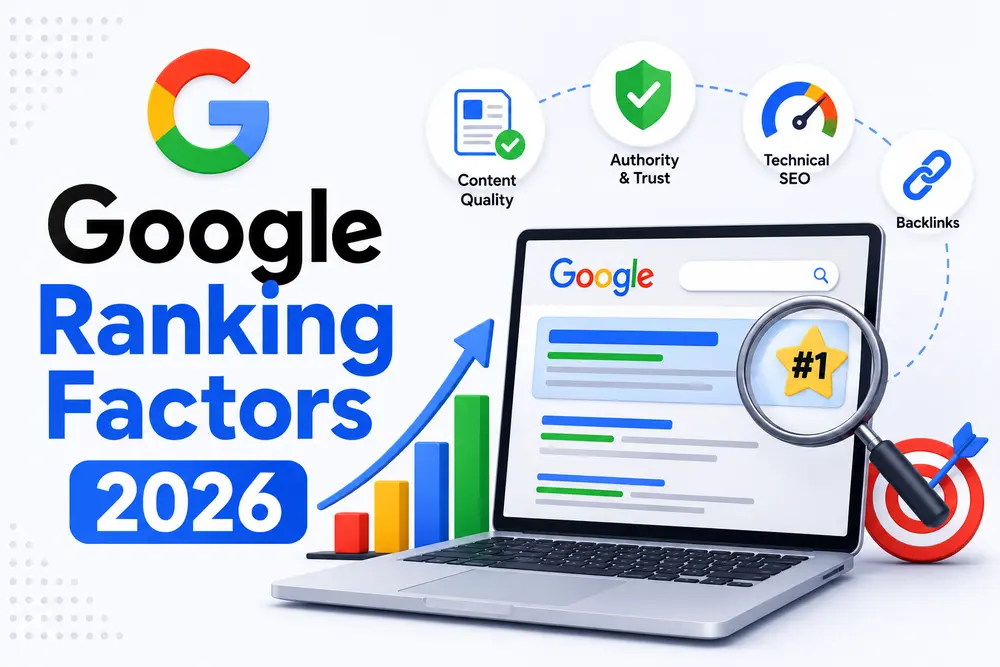
Ans. There isn't one single factor: content quality, technical health, and authority signals all work together.
4. How important are AI Overviews for traffic?
Ans. Very important for informational searches; appearing there can matter more than the traditional top organic spot.
5. Should small websites still bother with SEO?
Ans. Yes, smaller sites can rank well by targeting specific, less competitive long-tail keywords instead of broad terms.
6. How often should I update old content?
Ans. Reviewing top-performing pages every 6 to 12 months keeps them competitive and relevant.
7. Is keyword stuffing still a problem in 2026?
Ans. Yes, even unintentional overuse can hurt readability and rankings, so natural placement matters more than frequency.
8. Can I rank without a large marketing budget?
Ans. Yes, consistent content, solid technical basics, and genuine link-earning strategies work without paid promotion.