Long-Tail Keywords in 2026: How to Find and Rank for Low-Competition Search Terms
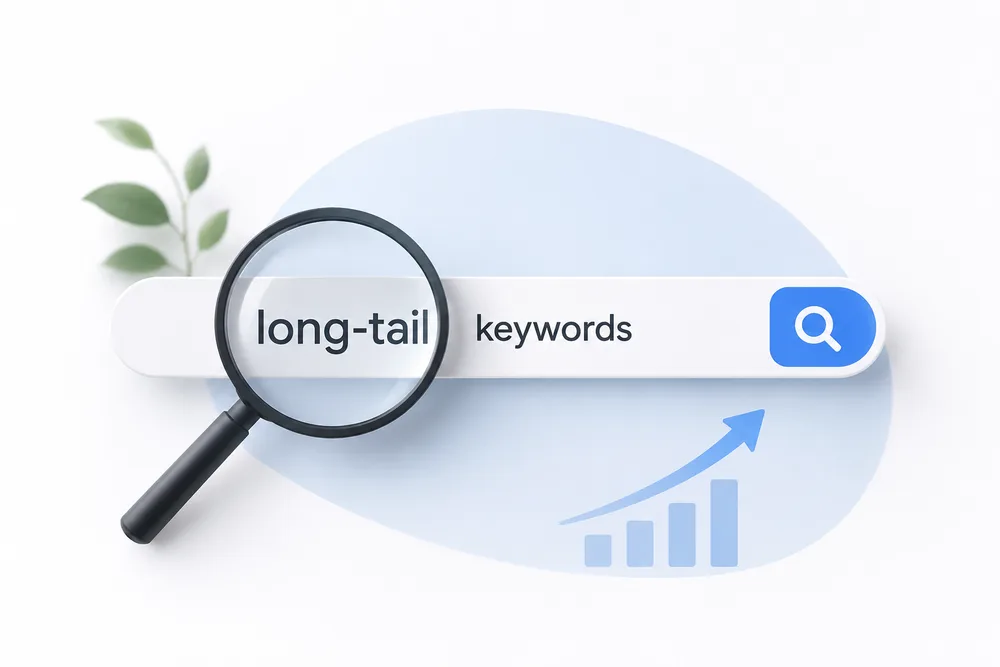
If ranking for big, obvious keywords hasn't worked out, long-tail keywords in 2026 are probably where you should be spending most of your effort instead. These are the longer, more specific search phrases, usually three words or more that individually don't pull massive traffic but collectively make up the bulk of what people actually type into Google. They're also, for most sites without a decade of built-up authority, the realistic path to actually showing up on page one.
This isn't a consolation prize for sites that can't compete for bigger terms. It's often the smarter strategy even for established sites, because long-tail traffic tends to convert better and gets less crowded out by huge competitors who've stopped bothering to chase such specific phrases.
What Actually Counts as "Long-Tail"
There's no strict word-count rule, despite what some guides imply. "Running shoes" is a short, broad head term. "Best running shoes for flat feet" is mid-tail specific, still a decent volume. "Best running shoes for flat feet and overpronation on a budget" is genuinely long-tail narrow, lower volume individually, but far easier to rank for and much more likely to match exactly what that specific searcher wants.
|
Keyword Type |
Example |
Search Volume |
Competition |
Typical Intent |
|
Head term |
"running shoes" |
Very high |
Extremely high |
Broad, mixed intent |
|
Mid-tail |
"running shoes for flat feet" |
Moderate |
High |
Narrowing down options |
|
Long-tail |
"best running shoes for flat feet and overpronation" |
Low-moderate |
Low-moderate |
Ready to decide or buy |
|
Micro long-tail / zero-volume |
"running shoes for flat feet marathon training beginners" |
Very low or untracked |
Very low |
Highly specific, often commercial |
The pattern holds across almost every industry. The more specific the phrase, the smaller the audience searching it, but the easier it is to actually win and often, the closer that searcher is to taking an action.
Why Long-Tail Keywords Matter More in an AI Search World
Here's something that's genuinely shifted the calculus recently. AI Overviews, ChatGPT search, and similar tools tend to favor specific, naturally phrased questions over broad, ambiguous terms which happen to be exactly what long-tail keywords already are. A page built around "how to fix a slow WordPress site on shared hosting" has a much better shot at being pulled into an AI-generated answer than a page vaguely targeting "website speed."
So rather than making long-tail strategy less relevant, AI search has arguably made it more valuable. Specific questions are what these systems are built to answer well, and specific content is what gets cited.
How to Actually Find Long-Tail Keywords
Finding these phrases doesn't require expensive tools, though paid ones speed things up considerably.
|
Method |
How It Works |
Cost |
|
Google Autocomplete |
Type a broad term and note what Google suggests before you finish |
Free |
|
"People Also Ask" boxes |
Capture the related questions Google surfaces for a search |
Free |
|
Related searches (bottom of results page) |
Reveals phrases Google associates with your original query |
Free |
|
Google Search Console |
Shows queries your site already gets impressions for, often long-tail already |
Free (once your site has traffic) |
|
Forums and communities (Reddit, Quora) |
Real, unfiltered language people use when asking for help |
Free |
|
Paid keyword tools (Ahrefs, Semrush) |
Bulk long-tail suggestions with difficulty scores attached |
Paid |
A method worth trying regardless of budget: take a broad seed keyword and add modifiers "for beginners," "on a budget," "without [common obstacle]," "vs [alternative]," a specific location, or a specific use case. These combinations consistently surface long-tail variations that generic keyword tools sometimes miss entirely.
Matching Long-Tail Keywords to the Right Content
Not every long-tail phrase deserves its own dedicated page. Grouping related long-tail keywords under one well-structured page usually performs better than scattering thin, separate pages across near-identical phrases Google tends to view that kind of splitting as diluting relevance rather than expanding coverage.
A reasonable rule: target one primary long-tail keyword per page, along with three to five closely related variations that share the same underlying intent. If a variation reflects a genuinely different intent informational versus transactional, for example it probably deserves its own separate page rather than getting crammed into the same one.
Common Mistakes With Long-Tail Strategy
A few patterns show up repeatedly when long-tail keyword efforts don't pay off the way people expect.
Chasing volume anyway, even after finding good long-tail options, is one of the most common. It's tempting to still pick the long-tail phrase with the highest number on paper, even when a lower-volume option matches your content and audience far better. Ignoring search intent is another long-tail phrase that looks informational but is actually being searched with clear buying intent (or vice versa) will underperform no matter how well the page is written.
Neglecting to track individual long-tail pages over time also causes problems. Since each one pulls modest traffic on its own, it's easy to lose track of which pages are actually working and which need revisiting. Checking performance every couple of months keeps that from becoming a blind spot.
Zero-Volume Keywords Aren't Necessarily Dead Ends
Some long-tail phrases show up as zero or barely-tracked volume in keyword tools, and it's tempting to write those off completely. But zero-volume in a tool's database doesn't always mean zero real searches; sometimes it just means the phrase is new, emerging, or too specific for a tool's tracking threshold to register reliably. If a phrase reflects a genuine, specific question your audience is likely asking, even without tool-confirmed volume, it can still be worth covering, especially since it costs little to include as part of a broader page already targeting a related, higher-volume long-tail term.
Wrapping Up
Long-tail keywords aren't a workaround for sites that can't compete for bigger terms; they're often the smarter strategy outright, especially with AI search increasingly rewarding specific, well-answered questions. Build content around real, narrow search phrases, group related ones thoughtfully instead of splitting them into thin separate pages, and keep an eye on which pages are actually converting. It's a slower, less flashy approach than chasing big head terms, but it tends to compound steadily in a way broad keyword targeting rarely does for smaller sites.
Frequently Asked Questions
1. How many words make a keyword "long-tail"?
Ans. There's no strict rule, but three or more specific words targeting a narrow intent is the general pattern.
2. Do long-tail keywords really bring meaningful traffic?
Ans. Individually, not much, but combined across many pages they often outperform chasing a few broad terms.
3. Are long-tail keywords still relevant with AI Overviews around?
Ans. Yes, AI search tools tend to favor specific, naturally phrased questions, which plays directly into long-tail strategy.
4. Should I target long-tail keywords with zero search volume?
Ans. Sometimes, especially if they reflect real questions your audience asks, even if tools don't track exact volume.
5. How many long-tail keywords should target one page?
Ans. One primary keyword plus three to five closely related variations sharing the same intent works well.
6. Are long-tail keywords easier to rank for than head terms?
Ans. Generally yes, since fewer high-authority sites bother competing for such specific, narrow phrases.
7. Can free tools find good long-tail keywords?
Ans. Yes, Google Autocomplete, People Also Ask, and Search Console cover most of what beginners actually need.
8. What's the biggest mistake with long-tail keyword strategy?
Ans. Choosing keywords based on volume alone instead of matching them to actual search intent.